
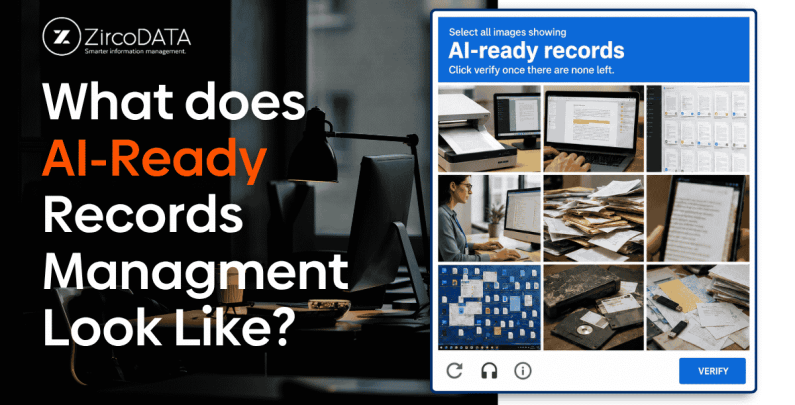
What Does AI-Ready Records Management Look Like?
AI can only work with the records it’s given, and right now most businesses aren’t giving it much to work with.
Every conversation about AI in business eventually lands on the same sticking point: the technology is only as good as the information sitting underneath it. That’s the whole game for anyone trying to get real value out of AI inside their organisation.
For records and information management, that game is moving fast. Komprise’s 2026 State of Unstructured Data Management survey found that 74% of organisations are now storing more than 5 petabytes of unstructured data, up 57% since 2024, with 40% already past the 10 petabyte mark. Gartner analysts speaking at its 2026 Data & Analytics Summit in Sydney went further, warning that businesses trying to build their own unstructured metadata solutions from scratch could spend over 300% more than if they’d used established document and records practices instead.
The businesses figuring out AI first are the ones whose records were already in order before they started.
Why is AI suddenly relevant to records management?
Contracts, scanned invoices, emails, case files, patient notes and supply chain paperwork make up the bulk of what a business generates, rarely the neat rows in a database people picture when they hear “data.” That’s unstructured data, and industry estimates now put it at somewhere around 80% of everything an average organisation holds. AI tools are built specifically to work across that kind of material, but only once it’s been catalogued, indexed and made accessible. An AI system can’t act on a box of files sitting in storage that it doesn’t know exists.
How does AI improve records management?
Automating the repetitive work. Categorising, filing and archiving documents at scale used to eat up hours of manual effort. AI-powered classification tools can read the content of a document and route it to the right location without someone doing it by hand, freeing staff up for work that needs a person’s judgement.
Making search and risk-spotting smarter. Keyword search only finds what you already know to look for. Semantic search, which is what most AI-powered records tools now run on, understands the intent behind a query and still works when staff aren’t sure of a document’s exact title. That matters enormously in legal, healthcare and government settings where one missing file can hold up an entire process. The same underlying tech can flag compliance risks, unusual access activity or gaps in retention before they escalate, giving records teams a head start on issues that would otherwise surface much later.
Does AI work the same way across every industry?
Not really, and it shouldn’t. A law firm needs AI that retrieves and cross-references case files fast. A hospital needs systems that manage patient records while meeting strict health information obligations. The technology is flexible, but it only earns its keep when it’s set up around how a specific industry works.
What’s stopping businesses from getting there?
Data privacy and security sit at the top of the list, for good reason. Any AI system touching business records needs clear governance, defined access controls and regular auditing, particularly where personal or sensitive information is involved.
The other sticking point is getting AI into the day-to-day operation. Bolting a tool onto decades of legacy systems and inconsistent file structures is rarely simple, and it gets expensive fast without a proper records foundation underneath it. It’s also where staff buy-in matters most: people who’ve spent years managing information a certain way are often, understandably, sceptical of a tool that promises to do it faster. That scepticism tends to ease once people see AI clearing out the tedious parts of the job and leaving the judgement calls to them.
Will AI replace records management jobs?
AI is good at classification, search and pattern detection at scale. The judgement calls around sensitivity, context and compliance still sit with experienced records staff. The organisations getting the most out of AI use it to clear the repetitive workload so their people can spend more time on that higher-value work.
How do you get started?
An honest audit of your current records, what’s digitised, what’s still sitting in physical storage, what’s being used, tells you more about where AI can help than any vendor pitch will. From there, a realistic implementation plan with clear goals and the right stakeholders in the room makes everything that follows far less painful. This is also where the right records management partner earns its value: someone who understands the AI layer and the information governance underneath it.
Where is this heading?
Natural language processing is making AI-powered search and retrieval more accurate and conversational by the year. Machine learning and process automation are steadily taking over more of the repetitive records workload. And as data volumes keep climbing, more of that processing is happening closer to where the data lives, which matters for organisations spread across multiple sites.
This is already happening inside organisations that got their records foundations right before the AI conversation started.
ZircoDATA has spent over two decades helping Australian organisations manage their information, and that experience now extends into building the AI-ready foundations records teams need. From document scanning and digitisation to culling and cataloguing, we help you get your records into shape before AI ever touches them.
Get in touch with the ZircoDATA team to talk through your records management needs.